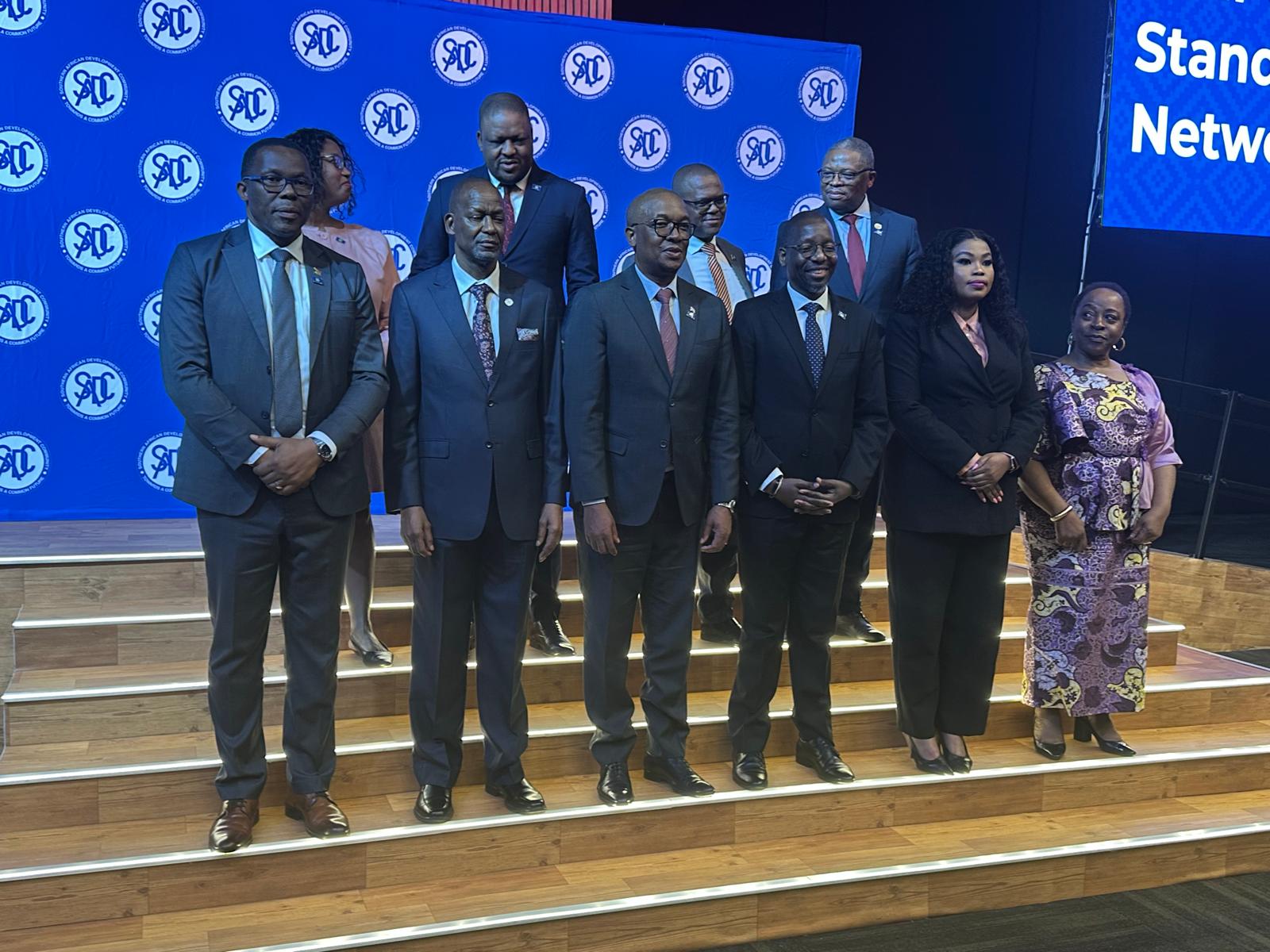
DURBAN, 27 July 2026. Heads of government, business leaders, investors and development finance institutions descend on the Durban International Convention Centre this week for the ninth SADC Industrialisation Week, a five day gathering running to 31 July under the theme “Resilient, Sustainable and Inclusive Industrialisation through Infrastructure Development, Agricultural and Critical Minerals Transformation in Pursuit of a Just World.” President Cyril Ramaphosa delivered the keynote address as guest of honour at the opening ceremony, joined by SADC Executive Secretary Elias Magosi and South Africa’s Minister of Trade, Industry and Competition, Parks Tau, who told delegates the region stood at a defining moment shaped by geopolitical shifts, technological change and the reconfiguration of global supply chains. The Centre for Artificial Intelligence and Sustainable Development is attending the gathering, represented by Co-Chair Dr Alexandre Essome, whose presence reflects a growing conviction among African policy institutions that the continent’s industrialisation drive can no longer be separated from its digital and artificial intelligence agenda.
The week’s programme, running through policy dialogues, technical sessions, seminars and workshops before closing with a factory visit showcasing South African manufacturing capability, serves as a high level precursor to the 46th SADC Summit of Heads of State and Government. It builds on the SADC Industrialisation Strategy and Roadmap 2015 to 2063, a framework resting on three pillars of industrialisation, competitiveness and regional integration. Four strategic priorities anchor the 2026 edition: strengthening regional value chains in agro-processing, pharmaceuticals, consumer goods and critical minerals beneficiation, expanding infrastructure in energy, transport, logistics, water and ICT, mobilising investment and industrial partnerships, and advancing women and youth empowerment, innovation and digital transformation.
Behind the programme sits a stubborn structural picture. Intra-regional trade within SADC remains stuck at roughly 18 to 19 percent, far below the near 60 percent recorded within the European Union, where member economies trade heavily in manufactured goods rather than raw agricultural products. Manufacturing value added across the region hovers around 11 percent, a figure that has barely shifted since the industrialisation study underpinning the current strategy was first adopted. The leather sector offers a striking illustration of what this stagnation costs. Raw hides and skins fetch as little as one to six United States dollars per unit on export, while a single pair of finished leather shoes, requiring roughly one square metre of material, sells for thirty to forty dollars. Much of the region continues to export livestock, hides and semi-processed wet blue leather to markets in Italy and India rather than completing the value chain at home, leaving the most profitable stages of production outside the continent.
Regional planners have settled on value chain specialisation as the corrective, encouraging member states to build capacity around their comparative and competitive strengths rather than each attempting to hold an entire value chain within national borders. Countries with large cattle populations would anchor animal husbandry and hide production, others would specialise in tanning and finishing, and the region as a whole would retain a larger share of the value currently captured elsewhere. Delivering on this vision depends on coordination across sixteen member states, reliable tracking of compliance and quality along cross-border supply chains, and stronger links between small and medium enterprises and the multinational manufacturers, such as vehicle assemblers, that could absorb their output. Most of the region’s small and medium enterprises remain informal, a status that has historically locked them out of the very business linkage programmes designed to connect them to multinational supply chains.
This is where artificial intelligence enters a conversation from which it has largely been absent. Africa’s AI market, valued at roughly 4.51 billion United States dollars in 2025 and projected to reach 16.53 billion dollars by 2030, is increasingly treated by economists as inseparable from the continent’s industrial prospects rather than a parallel digital story. Research examining anchor commodities such as cocoa, coffee and sugarcane across West, East and Southern Africa has mapped how artificial intelligence can support traceability, compliance verification, quality grading, climate adaptation, logistics optimisation, customs automation and trade finance along regional value chains. The same categories apply directly to the leather, agro-processing and critical minerals chains that anchor this year’s Industrialisation Week. An AI-enabled traceability system tracking hides from animal husbandry through tanning to finished leather would give member states a reliable way to verify where value addition is genuinely occurring, strengthening the case for keeping finishing stages within the region instead of exporting semi-processed inputs abroad.
Corridor logistics present a second opening. The North-South Corridor and the Lobito Corridor remain underutilised relative to their potential, and delegates at this year’s Industrialisation Week are expected to push for concrete policy commitments on corridor use. AI-driven logistics tools, already applied in African retail and manufacturing through demand forecasting, route planning and predictive maintenance, offer a practical way to raise corridor utilisation without new capital works. Customs automation, increasingly cited in research on the African Continental Free Trade Area, speaks directly to the non-tariff barriers that continue to slow cross-border trade for smaller producers.
Small and medium enterprise empowerment, one of the four strategic priorities confirmed for this year’s edition, is arguably where the AI contribution could be felt soonest. Natural language processing tools built for African languages, alongside AI systems for business documentation and compliance guidance, lower the technical literacy barrier that has kept informal enterprises outside formal linkage programmes. Agentic AI applications capable of handling routine compliance, invoicing and market-matching tasks with limited supervision are being described by technology analysts as a genuine competitive advantage available to Africa’s next generation of enterprises, provided digital infrastructure and skills keep pace. That proviso matters. Continental research is consistent in warning that AI’s industrial benefits are conditional on pairing innovation with inclusion, regional coordination and infrastructure investment, not on assuming that technology alone will resolve structural constraints.
For CAISD, a Centre working at the intersection of artificial intelligence and sustainable development across Africa, this year’s Industrialisation Week offers more than an observation point. Dr Essome’s attendance signals the institute’s intent to engage directly with the regional value chain, infrastructure and MSME agendas under discussion in Durban, building on CAISD’s existing work in precision agriculture and diagnostic technology, both of which rest on adapting AI tools to African production realities rather than importing them wholesale. That same principle applies to industrialisation more broadly. As member states discuss critical minerals beneficiation, agro-processing and regional value chains this week, the region has an opening to treat artificial intelligence as a deliberate design feature of its industrial strategy rather than an afterthought, one capable of helping move manufacturing value added beyond the eleven percent mark that has held steady for years.
The Industrialisation Strategy and Roadmap runs to 2063, a horizon long enough to absorb technological change not yet written into its text. This week in Durban offers member states, the private sector and research institutions such as CAISD a timely opportunity to begin writing it in.
Leave a Reply