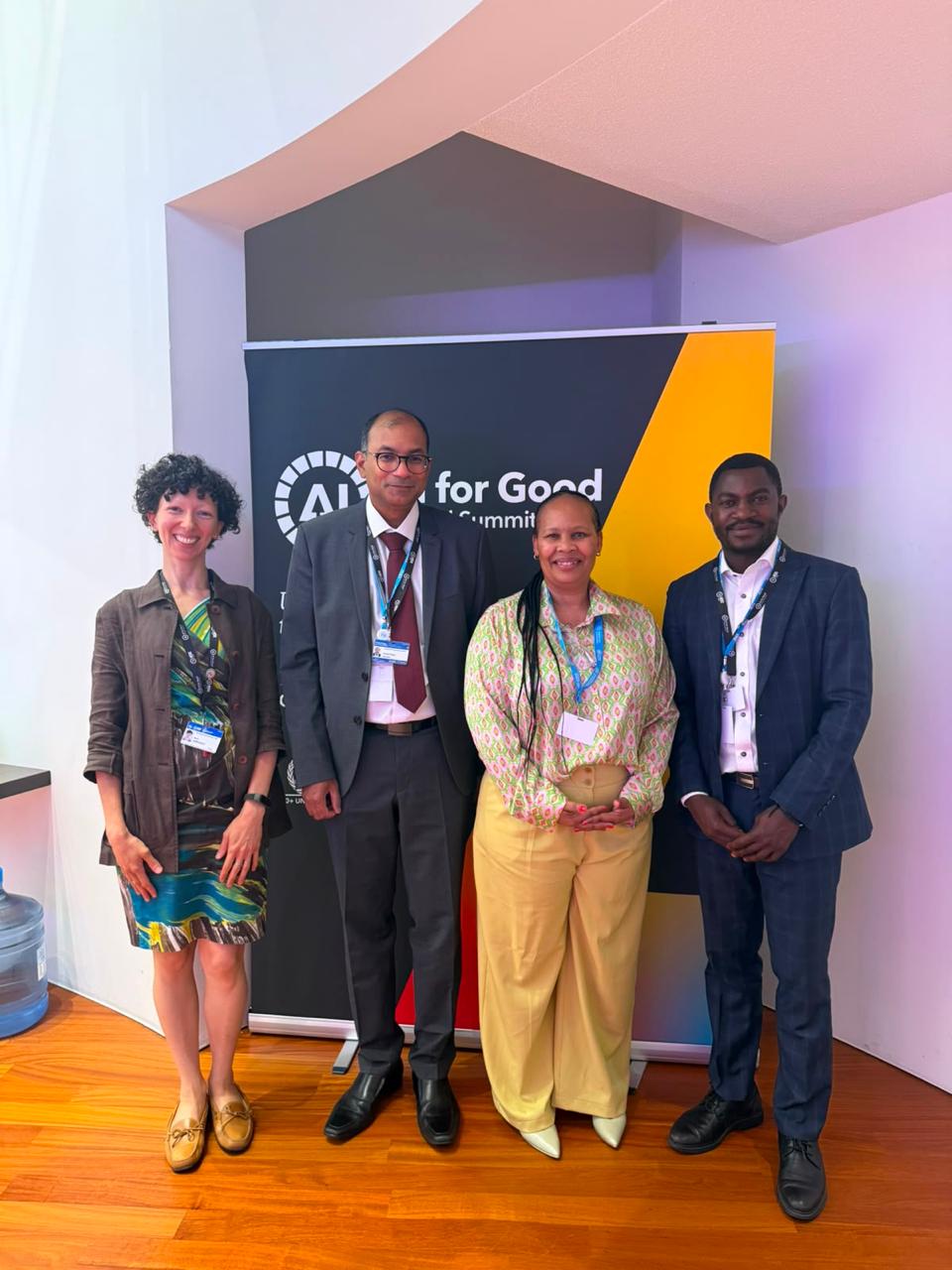
“CAISD argues that Africa’s Policy Choices ought to be finalized the soonest”
Artificial intelligence governance has moved, within the space of a single year, from a subject debated mainly in technology ministries to one that sits squarely inside development planning, industrial strategy and constitutional practice. This article draws together the proceedings of the United Nations Global Dialogue on AI Governance, held in Geneva on 6 and 7 July 2026, and identifies the governance directions now taking shape globally and what they mean for policymaking on the African continent. It situates the Dialogue within the current body of thinking on AI divides, compute governance and institutional readiness, and asks what direction African governments, South Africa’s included, should now take. In doing so, it seeks to contribute a policy-oriented reading of a fast-moving debate to an audience that must translate global commitments into national decisions.
Centre of Artificial Intelligence and Sustainable Development www.CAISD.Africa),participation in the dialogue gave us the opportunity to witness the proceedings first hand. The UN Dialogue was more than a technical forum and it was a necessary platform that tested the assumptions, readiness and legitimacy of current global AI governance approaches. The UN Dialogue revealed that governance cannot remain concentrated among technologically advanced countries and dominant private-sector actors, and that it must instead become a sustained mechanism for addressing AI safety, data governance, human rights, digital inclusion, capacity-building, compute access and Africa’s meaningful participation in shaping future AI systems. After being part of the proceedings in Geneva, we can argue that Africa must now build on the relationship formed in Geneva and translate it into institutional opportunity, knowing that the urgent framing of AI governance maturity assessments, data stewardship, skilling and research partnerships are areas of priority to improve its own readiness to AI Governance. We need to translate the dialogue into intentional actions.
A Dialogue Born of Urgency
The Geneva Dialogue did not emerge from nowhere. It followed more than a year of structured global consultations, drawing over 1,500 written submissions from governments, civil society, academia and industry across every region. UN Secretary-General Antonio Guterres opened proceedings with a message that was as much a warning as an invitation, arguing that “artificial intelligence, used well, could compress decades of development into a matter of years and become what he called the great equalizer of the twenty-first century”, but only if the international community first agrees on how systems are tested, how risk is measured and how responsibility is assigned, Guterres added. The European Union’s statement to the Dialogue described it as a unique moment, the first occasion on which the entire UN membership had gathered specifically to discuss AI governance and stressed that broad-based participation was a precondition for the legitimacy of whatever followed. The Dialogue closed with an unusually candid acknowledgement from its co-chairs that Geneva should be read as a beginning rather than a conclusion, with progress before the second Dialogue in New York in May 2027 to be measured in tangible improvements to inclusion and capacity rather than new declarations.
Much of the language used in Geneva, on bridging AI divides and ensuring no country is left behind, can sound aspirational until it is set against the underlying data. Recent analysis from the Centre for Strategic and International Studies notes that Africa accounts for less than one percent of global data centre capacity despite representing eighteen percent of the world’s population, a gap current investment trends are unlikely to close on their own. A 2026 mapping study of AI infrastructure financing across the continent goes further, arguing that compute governance cannot be reduced to a question of geography, since capital and infrastructure account for the majority of announced investment while control over the compute layer remains concentrated among a small number of global technology firms, a pattern the authors term “asymmetrical interdependence”. This is the harder version of the AI divide that Geneva’s rhetoric of inclusion must eventually confront. Regional co-ordination, through mechanisms such as the African Union and shared compute consortia, is repeatedly identified in current research as the more realistic route to scale than isolated national buildouts, since pooled infrastructure can reduce costs substantially compared with fragmented national efforts.
Principles Are Necessary but Insufficient: The Evidence Problem
The Independent International Scientific Panel report on AI fundamentally framed a dilemma that deserves more attention in African policy circles than it currently receives. Governance decisions require solid evidence, yet technology changes faster than evidence can be produced reliably. South Africa’s recent experience illustrates the cost of getting this wrong. The Draft National AI Policy, gazetted for public comment in April 2026 after Cabinet approval, was withdrawn in June 2026 after its reference list was found to contain fabricated citations, an unmistakable sign that AI-generated content had entered the drafting process without adequate human verification (Ellipsis, 2026). A revised version is now expected to return to Cabinet later in 2026, with public release anticipated in early 2027. The episode is a useful, if uncomfortable, case study of the evidence dilemma Geneva placed at the centre of its discussions. It confirms that institutional readiness is not simply a matter of having a policy on the shelf, but of having the internal capacity and verification systems to produce one credibly.
South Africa’s approach, once finalised, is expected to embed AI oversight within existing sector regulators rather than create a single new authority, organised around five pillars covering skills, governance, ethics, cultural preservation and human-centred deployment. This model has clear advantages in a resource-constrained environment, but it raises the interoperability question that recurred throughout Geneva: how a sector-based domestic framework connects coherently to emerging international norms on assurance, data governance and human rights. Kenya’s multistakeholder workshop with the OECD in March 2026 reached a similar conclusion from a different angle, recommending risk-based regulation and regional co-ordination on shared benchmarks and data-sharing as a response to the scale constraints facing individual states. The direction of travel is consistent: effective AI governance is converging on risk-based, interoperable and regionally co-ordinated models, rather than heavy centralised regulation or a purely voluntary approach.
Looking Forward: Policy Directions Worth Testing
CAISD proposed four directions following the UN proceedings for African governments weighing their next moves. First, evidence infrastructure should be treated as a governance priority, meaning dedicated technical and research capacity to verify claims, data and citations before they enter policy instruments, learning directly from South Africa’s recent experience. Second, compute strategy should be pursued regionally rather than nationally wherever possible, since pooled infrastructure investment offers a more realistic path to meaningful capacity than isolated national data centre projects. Third, domestic AI frameworks, whichever institutional model they adopt, should be designed from the outset for interoperability with the standards and assurance mechanisms now taking shape internationally, rather than retrofitted later. Fourth, African governments should use the eighteen months before the 2027 New York Dialogue deliberately, arriving with implemented commitments rather than fresh statements of intent, since that is the metric by which Geneva’s own participants said the process should be judged. The direction AI governance is heading in is now reasonably clear. What remains uncertain is whether African institutions will help set that direction or simply adapt to it after the fact.
Leave a Reply