A Policy Roadmap for African Governments
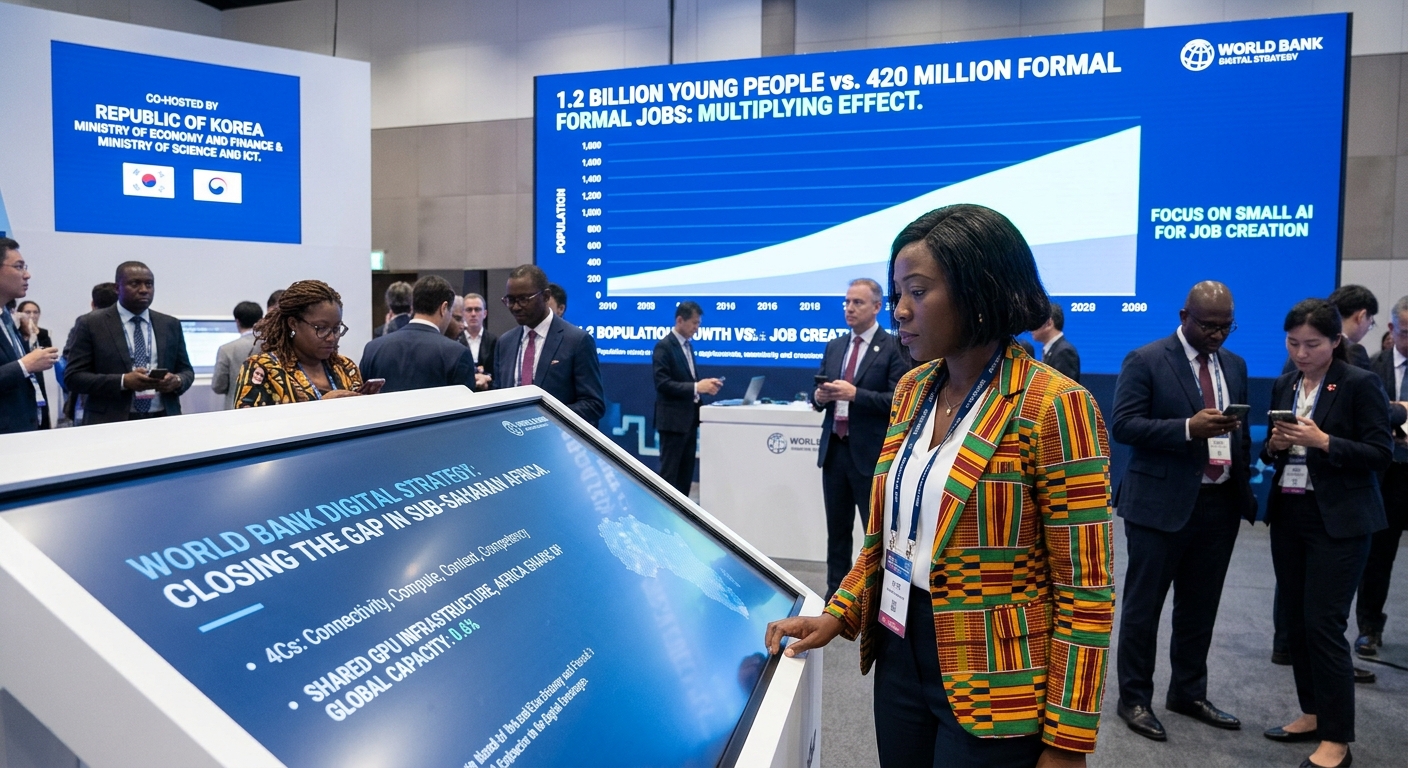
On 20 October 2026, the World Bank Group unveiled its first-ever comprehensive Digital Strategy during the Global AI and Digital Summit in Seoul, co-hosted with the Republic of Korea’s Ministry of Economy and Finance and Ministry of Science and ICT. Attended by approximately 900 delegates across 160 countries, the summit marked a structural shift in how international development assistance is designed, financed, and deployed.
Concurrently, the World Bank introduced its AI Infrastructure and Readiness Initiative, targeting initial rollouts across Africa and Latin America. As the primary multilateral financier for infrastructure and development across the African continent, when the World Bank aligns its lending portfolios, advisory frameworks, and risk-mitigation guarantees around digital architecture and artificial intelligence, national budgets, sovereign debt negotiations, and sector-specific ministry strategies inevitably pivot in response.
This transformation represents a global governance moment as much as a technological transition. For African policymakers, the World Bank’s strategy offers a structured pathway to bypass traditional capital-intensive data center deployments in favor of shared, flexible compute models. However, capitalizing on this moment requires immediate, proactive national alignment, rigorous public finance oversight, and coordinated regional policy frameworks.
The Development Gap: Coverage vs. Affordability
Despite widespread telecommunications expansions over the past decade, significant digital exclusions persist across developing economies. As highlighted in the strategy’s baseline metrics:
- Over 2 billion people remained offline in 2025, with internet utilization standing at 23% in low-income countries, compared to 94% in high-income economies.
- The primary barrier to digital inclusion has shifted from physical network reach to affordability and practical utility. Millions of citizens reside within mobile broadband coverage zones but are excluded due to the high cost of entry-level smartphones, expensive mobile data tariffs, limited digital skills, or a lack of relevant localized digital services.
Demographic projections emphasize the urgency of this transition: over the next 10 to 15 years, approximately 1.2 billion young people in developing countries will reach working age, while these economies are currently projected to generate only about 420 million formal jobs. World Bank Group President Ajay Banga’s framing positions digital technology as an essential force multiplier to “create jobs and make scarce resources go further.” The Bank has explicitly anchored its digital strategy around five core job-creating sectors: infrastructure and energy, agribusiness, health care, tourism, and value-added manufacturing.
The strategy is structured across four interrelated operational priorities, undergirded by mandatory safeguards for privacy, cybersecurity, and fraud protection:
- Expanding Reliable Connectivity: Closing infrastructure gaps from submarine landing cables and national fiber backbones to last-mile connections for homes, schools, clinics, and businesses. Priority is placed on public-private partnerships (PPPs) and co-planning electricity grid extensions alongside telecom lines.
- Lowering Device and Data Costs: Reducing financial barriers to entry-level smart devices and broadband access via structured partnerships across device manufacturers, telecom operators, financial institutions, and device refurbishment enterprises.
- Scaling Digital Services and Skills: Developing public infrastructure specifically digital identification, interoperable payment rails, and secure data exchange layers paired with targeted vocational training to enhance digital literacy.
- Building AI Readiness: Strengthening foundational digital infrastructure, enabling access to compute resources, curating actionable localized datasets, and driving AI competency. The explicit focus is placed on “Small AI” targeted, domain-specific AI tools tailored to regional conditions (e.g., crop disease detection, clinical diagnostic support, and SME inventory management).
The AI Infrastructure and Readiness Initiative & Shared Compute
A core operational component of the strategy is the AI Infrastructure and Readiness Initiative, created to provide governments with pay-as-you-go GPU infrastructure as an alternative to building capital-intensive, standalone national data centers.
Sub-Saharan Africa accounts for 18% of the global population but currently holds only 0.6% of worldwide data center capacity, with less than 5% of that capacity being AI-ready (high-density power and specialized GPU clusters). Standalone sovereign data centers often suffer from low utilization rates, stranded capital, and rapid hardware obsolescence.
Key Metric Deficits
| Sub-Saharan Share of Global Population | 18.0% |
| Sub-Saharan Share of Global Data Center Capacity | 0.6% |
| Share of African Data Center Capacity AI-Ready | <0.3% (5% of 0.6%) |
Institutional Design and Partnerships
To address this gap, the World Bank will assist client countries in evaluating compute requirements across cloud-based, distributed, regionally shared, or sovereign deployments, supported by a newly established Digital Access Fund for underserved markets.
The initiative leverages private-sector knowledge partners, including NVIDIA and Cassava Technologies (founded by Strive Masiyiwa). In March 2025, Cassava and NVIDIA announced Africa’s first “AI Factory” network, deploying 12,000 NVIDIA GPUs across five key hubs (South Africa, Egypt, Kenya, Morocco, and Nigeria) to offer GPU-as-a-Service (GPUaaS) hosted by Africa Data Centres.
Transparency on Key operational details
The initial list of beneficiary countries, total fund allocation, launch dates, GPU ownership structures, and final pricing mechanisms remain undisclosed. CAISD advocates for complete data disclosure from the bank to enable monitoring of the process. Governments must maintain a clear distinction between knowledge partners and solution suppliers, enforcing strict, open, competitive procurement standards.
Grounding in the World Bank’s Analytical Frameworks
The digital strategy is anchored by two foundational World Bank publications:
Digital Progress and Trends Report 2025: Strengthening AI Foundations Establishes the “4Cs” framework necessary to support national artificial intelligence ecosystems:
- Connectivity: High-speed broadband and resilient power networks.
- Compute: Scalable hardware processing capacity (GPUs/TPUs).
- Context: Localized datasets, regional languages, and domain-specific use cases.
- Competency: Human capital, developer talent, and organizational readiness.
World Development Report 2026: The Promise of Artificial Intelligence
Offers key directives for emerging markets:
- Focus on Small AI over Frontier Models: Recommends diffusing task-specific, low-parameter models over costly frontier Large Language Model (LLM) training.
- Prioritize Interoperability over Strict Sovereignty: Advises against costly, isolated national infrastructure bets, encouraging open standards and shared cross-border architectures.
- Drive Adoption in Foundational Sectors: Focuses policy interventions on AI absorption within small-scale agriculture, informal trade, and primary healthcare services.
Strategic Opportunities for Africa
Leapfrogging via Practical AI Applications: Small AI models run efficiently on modest compute workloads, delivering high-impact outcomes in precision agriculture extension, triage in community health clinics, and customs management.
Blended Finance Mobilization: World Bank guarantees and the Digital Access Fund help de-risk private investment in middle-mile fiber, renewable energy, and data centres. African economies should where possible utilise PPP model with world bank guarantees to finance this infrastructure
Africa needs to aggregate national demand through Regional Economic Communities (SADC, EAC, ECOWAS) and the AfCFTA enhances collective bargaining power with global technology vendors so that they speak with one voice and avoid the reace to the bottom as previously witnessed
Policy Recommendations for African Governments
The Centre for Artificial Intelligence and Sustainable Development (CAISD) recommends that African ministries of finance, communications, and economy take the following actionable steps:
Action 1: Formally Register Interest Immediately. Ministries of Finance and ICT should jointly submit formal requests to their respective World Bank Country Directors to be included in the AI Infrastructure and Readiness Initiative pipeline and request an immediate national compute needs assessment.
Action 2: Adopt a National “Small AI” Agenda. Avoid resource-intensive frontier model races. Formally designate 3 to 5 high-priority national use cases such as agricultural advisory services, tax risk analysis, or maternal healthcare support and quantify their exact compute demands prior to procurement.
Action 3: Integrate Power and Digital Planning. Ensure national energy regulators and telecom authorities jointly plan data center power requirements. Grid constraints that delay infrastructure projects serve as a clear warning: power availability must precede compute deployment.
Action 4: Establish Legislative Safeguards Prior to Procurement. Enact and update national data protection laws, cybersecurity standards, and risk frameworks aligned with the AU Data Policy Framework, the Malabo Convention, and the UN Global Digital Compact.
Action 5: Pool Regional Demand. Work through SADC, EAC, ECOWAS, and AfCFTA structures to aggregate regional compute demand, build shared cross-border data spaces, and align with the AU Continental AI Strategy.
Action 6: Safeguard Public Finances. Finance ministries and sovereign debt management offices must evaluate pay-as-you-go software/hardware commitments and guarantees as potential contingent liabilities, setting strict exposure caps and ensuring contract transparency.
Action 7: Maintain Technical Interoperability. In alignment with WDR 2026, avoid vendor lock-in by enforcing open-source standards, strict exit clauses, and clear data residency rights in all cloud contracts.
Action 8: Build Local Context and Competency. Fund localized dataset development (including native language corpus building) in partnership with regional universities and national research institutions.
Action 9: Diversify Development Partnerships. Balance World Bank programs alongside complementary initiatives offered by the African Development Bank (AfDB), UN agencies, BRICS framework channels, and bilateral partnerships such as the Korea-Africa AI Hub.
Action 10: Establish Metric-Driven Monitoring. Link every digital infrastructure project to measurable economic indicators such as net job creation, public service coverage expansion, and unit cost reductions and publish annual performance audits.
Conclusion
The World Bank’s Digital Strategy provides vital financial instruments, credit guarantees, and shared compute frameworks to narrow the global digital divide. However, these multilateral facilities do not substitute for rigorous national planning. The nations that align their energy planning, regulatory safeguards, public finance management, and localized AI priorities today will gain the greatest strategic advantage when project selections and funding allocations are finalized.
Leave a Reply