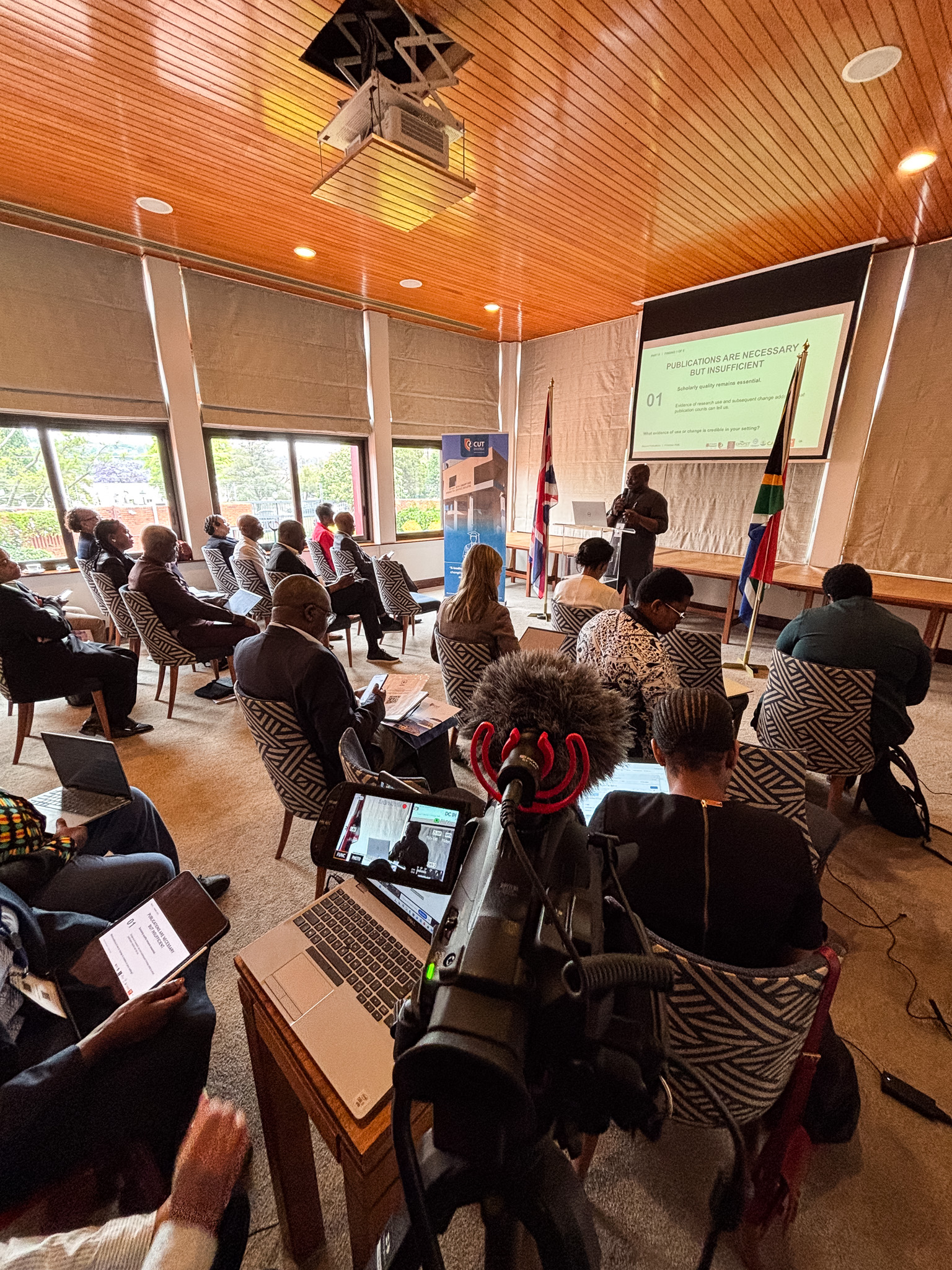
On Monday 5 October 2026 in Waterkloof, Pretoria, researchers, policymakers, industry leaders, community representatives and environmental voices gathered inside the British High Commission Conference Centre. The purpose was clear and urgent. To test a simple but uncomfortable question that has troubled Southern African universities for years. If a researcher publishes a rigorous paper and no one outside the academy ever uses it, what has changed?
The validation workshop, titled Beyond Publications: Measuring and Incentivising Academic Research for Social Impact in Southern Africa, was led by the Central University of Technology, Free State (CUT) in close collaboration with the Centre for Artificial Intelligence and Sustainable Development (CAISD). The British High Commission Conference Centre in Waterkloof opened its doors as the venue because the UK Foreign, Commonwealth and Development Office (FCDO) Evidence Fund supports the work. Consortium partners include the University of Johannesburg, Leeds Beckett University in the United Kingdom, the Botswana International University of Science and Technology (BIUST) and the Namibia University of Science and Technology (NUST).
The room and online links brought together the five helices that the project places at the centre of meaningful research: academia, government, industry, communities and the natural environment. Vice-chancellors, deputy vice-chancellors, senior government officials, mining and construction practitioners, traditional leaders, civil society actors, environmental regulators and development partners from South Africa, Botswana, Namibia, Zambia and Zimbabwe sat at the same tables. Their presence itself sent a message. Research that hopes to serve the region cannot remain inside university walls.
When Publications Alone Fail Local People
For decades Southern African research systems have rewarded the journal article above almost everything else. Subsidy formulas, promotion criteria and ranking exercises count publications and citations. The result is predictable and painful. Highly cited papers often leave no visible mark on households, clinics, farms, municipalities or ecosystems. One participant at the workshop described the quiet frustration of being well published yet unable to point to a single community that had benefited from the work. Another noted that white papers sit unread in institutional repositories while district officials continue to plan without the evidence they need.
The project team placed five findings on the table. Publications remain necessary but are not enough. Incentives shape what researchers choose to study. Pathways from laboratory to society differ across countries and institutions. Translation and follow-up require deliberate support. Credibility depends on whose voices are heard and what safeguards protect them. These findings were drawn from more than forty analytical cases and nearly two thousand evidence units across the five focus countries. Participants tested every claim. Almost no one disputed the need for scholarly quality. The sharp debate centred on the missing middle: the space between a published paper and a change that ordinary people can feel.
Five Helices Must Shape Every Research Agenda
The workshop’s strongest consensus was practical. Future research design, funding and assessment must take the five helices seriously from the first question to the final evaluation. Academia produces knowledge. Government sets policy and delivers services. Industry turns ideas into products and jobs. Communities define relevance and carry local knowledge. The natural environment sets ecological limits and generates its own signals through climate data, biodiversity loss and resource stress. Dr Alexandre Essome, Co-Chair at CAISD, has consistently championed this collaborative posture. Through CAISD’s work he argues that “the five helices must talk to one another more deliberately if research is to serve local populations”. He added that when any helix is treated as an afterthought, impact shrinks. “When communities help frame the research question, when industry partners test prototypes early, when environmental regulators supply binding constraints and when government channels create uptake pathways, the chance that findings reach households rises sharply.”
Participants insisted that measurement must follow the same logic. The workshop explored concrete ways to track outcomes that matter to local people: changes in service delivery, new green technologies adopted by small enterprises, policy briefs used by municipal planners, oral knowledge systems respected and protected, and ecological safeguards built into project design. The emerging framework offers shared core principles, clear pathways and six decision gates that institutions can adapt to their own contexts. It remains a framework to be finalised in the coming weeks with inputs from participants who supported, revised and disputed elements in the framework.
Technology and Artificial Intelligence as Force Multipliers
A key intervention came from the CUT leadership. The Acting Vice-Chancellor, Professor Samson Mashele, and senior colleagues stressed that technology and artificial intelligence must be used more deliberately if research is to travel beyond the journal. Rigour stays non-negotiable. A publication records a discovery. Impact records what that discovery changes. “Technology and Artificial intelligence can now summarise technical papers into plain language, translate them into local languages and produce audio formats that reach extension officers, clinic managers and community leaders” he explained. Digital systems can track uptake automatically so that funders no longer wait months for researchers to report whether anyone used the findings.
The British High Commissioner representative, Ms Leanne Jones welcomed participants and underlined the High Commission’s continuing support. She noted that once the framework is finalised the British High Commission stands ready to help carry the conversation further so that impact is realised at local level. The commitment was practical rather than ceremonial. Engagement after publication is as important as the publication itself. Professor Alfred Ngowi who is leading the research, explains the workflow of the day and what was expected of the participants, which was, according to him, “a robust engagement resulting to validation and not an approval of the early findings”.
Guarding Against New Narrow Metrics
Participants were careful. Digital tools do not automatically mean inclusion. Communities are not uniform. Consent, knowledge rights and local authority must be protected, especially where indigenous knowledge is involved. Small enterprises and early-career researchers need clear, fair rules rather than vague equity language. Academic participants asked for quantified evidence requirements so that researchers know exactly what to submit. Without these safeguards a technology-driven scorecard could simply replace one narrow metric with another.
The conversation also placed Southern African research inside larger continental frames. Agenda 2063’s vision of the Africa We Want, the uneven progress toward the 2030 development goals, and the value of SADC-wide collaboration and qualification recognition all featured. Cross-border knowledge exchange, supported by technology cooperation under frameworks such as BRICS and the United Nations system, can amplify African priorities only if those priorities are set in Africa first.
Looking Ahead
Open questions remain. How community is defined in practice, how co-creation differs from co-production, who the framework ultimately serves, and whether all six gates should carry equal weight. For CAISD the lesson is direct. Southern Africa does not need fewer publications. It needs publications that travel through accessible language, trusted partnerships across the five helices, and digital systems that connect findings to the people who can use them. Professor Alfred Ngowi and the consortium have placed a clear framework on the table. The validation workshop tested it under real conditions. The measure of success will not be another journal article. It will be what changes in communities, policy rooms, workshops and ecosystems across the region.
Leave a Reply