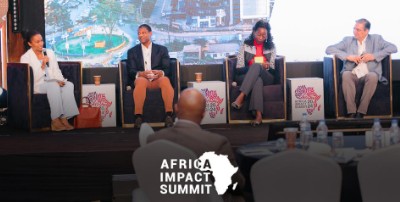
The Africa Impact Investment Summit (AIIS) returns to the continent in June 2026, anchored in Lusaka, Zambia, at the Ciela Resort from 10 to 12 June. Under the theme “Beyond Borders: Scaling Impact and Innovation for Africa’s Sustainable Transformation,” the summit convenes policymakers, investors, entrepreneurs, civil society actors, and development practitioners from across Africa and beyond. For those of us working at the intersection of technology, governance, and sustainable development, this is not simply another conference on the calendar. It is a deliberate gathering of people who understand that Africa’s development challenge cannot be solved by aid flows alone, and who are prepared to build the systems, relationships, and frameworks that make transformative investment possible. The Center of Artificial Intelligence and Sustainable Development www.CAISD.co.za based in Pretoria will be in attendance with and\ considers this summit a strategic priority, and what the broader development community stands to gain from being in the room.
The Summit and Its Architecture
The Africa Impact Investment Summit is hosted by the Africa Impact Investing Group (AIIG), a multi-country network affiliated with the Global Steering Group for Impact Investing (GSG). Established in May 2022 in Turin, Italy, the AIIG brings together national partners from Kenya, South Africa, Ghana, Nigeria, and Zambia, with a mandate to accelerate the deployment of impact capital across the continent.
The summit is co-anchored by NABII Zambia, the National Alliance for Business Impact Investing, which has been building the country’s impact investing infrastructure with notable consistency. The choice of Lusaka as the 2026 host is analytically significant. Zambia sits at an interesting developmental juncture. It has navigated a difficult debt restructuring process, is rebuilding fiscal headroom, and is simultaneously trying to position itself as an innovation-friendly economy. The summit arrives at a moment when domestic appetite for structured impact investment is growing, and when international capital is actively looking for credible entry points into the Southern African market.
Why CAISD Thinks This Summit Is Worth It
Our institutional calculus is straightforward. We go where decisions are being shaped, where frameworks are being negotiated, and where relationships that translate into action can be built. The AIIS meets all three criteria, and the 2026 edition does so with particular force. The summit’s thematic focus on scaling innovation and crossing borders maps directly onto CAISD’s core mandate. Africa’s sustainable development challenge is fundamentally a governance and systems problem, not merely a funding shortfall. Across the continent, promising innovations in agriculture, health, education, and financial inclusion are failing to scale not because the ideas are weak, but because the institutional environment, the regulatory frameworks, the data infrastructure, and the investment pipelines needed to sustain them remain fragmented and underdeveloped. CAISD exists precisely to address this gap, and the AIIS is the kind of convening where that argument can find a receptive audience.
CAISD is advancing several initiatives, including a precision agriculture and AI pilot in Vanderbijlpark, a university innovation partnership with UNDP Zambia, and a continental AI governance programme, all of which require the kind of blended finance, patient capital, and institutional co-investment that impact investors at this summit are positioned to provide.
Innovation as a Development Strategy
One of the most substantive threads running through this summit will be the work of UNDP in Zambia, and it deserves analytical attention rather than a passing mention. UNDP has evolved significantly in recent years from a traditional grant-making and technical assistance body into an active architect of innovation ecosystems. In Zambia, this shift is visible in programmes designed to connect university talent with digital tools, entrepreneurship support, and seed capital in ways that build long-term institutional capacity rather than short-term project outputs.
The UNDP UniPod model is a case in point. Embedded within university of Zambia (UNZA) campus, UniPods are designed to democratise access to innovation infrastructure, giving students and young researchers the space, connectivity, mentorship, and early-stage funding they need to convert ideas into viable enterprises. CAISD is engaged with this model through our partnership with UNDP Zambia, and the evidence from early implementation is instructive. The constraint on African innovation is rarely a shortage of ideas. It is the absence of structured pathways from ideation to prototyping to market entry, combined with a policy environment that has not yet caught up with the pace of technological change.
UNDP’s Africa Market Insights Report adds a further analytical layer, providing systematically gathered data on where private sector investment opportunities align with development priorities across ten African economies. For impact investors navigating a continent where information asymmetries are significant and due diligence costs are high, this kind of evidence infrastructure is not a nice-to-have. It is a prerequisite for responsible capital deployment, and UNDP’s willingness to produce and share it publicly is one of the more underappreciated contributions it makes to the continent’s development ecosystem.
AI, Innovation, and the Investment Frontier
For CAISD, the summit also advances a specific and urgent argument that artificial intelligence is not a future consideration for African development. It is a present-tense investment frontier that demands immediate governance attention. Across precision agriculture, financial inclusion, healthcare diagnostics, and education technology, AI-enabled solutions are already demonstrating measurable development returns in African contexts. The question is no longer whether AI will shape Africa’s development trajectory. It is whether the continent will build the regulatory frameworks, data governance standards, and institutional capacity to ensure that it does so equitably and sustainably.
Impact investors who enter the AI space without engaging these governance questions risk financing systems that entrench inequality rather than reduce it. Algorithmic tools trained on unrepresentative data, deployed in contexts without accountability mechanisms, and scaled through investment vehicles that prioritise financial returns over social outcomes can cause real harm at speed and at scale.
The Summit Is Where You Need to Be
The AIIS is one of a very small number of convening spaces on the continent where the full architecture of impact investing, spanning national policy, institutional frameworks, enterprise pipelines, and capital markets, is in the same room at the same time. The Africa Impact Investing Awards, the UNDP-hosted side events, and the bilateral dialogue spaces collectively create conditions for the kind of multi-stakeholder alignment that no single organisation can manufacture on its own. For practitioners, policymakers, and investors who are serious about Africa’s development, Lusaka in June is not optional. It is where the work gets done.
Leave a Reply